
Comanche Parole Versus Probation
Texas parole and mandatory supervision follow confinement in the Texas Department of Criminal Justice. Release decisions are made within the Texas Board of Pardons and Paroles framework, while the TDCJ Parole Division supervises the person in the community. Probation does not require a prior state prison release. A Comanche County court can place a defendant directly on community supervision or continue that status after a local jail sanction.
| Point | Parole or mandatory supervision | Probation |
|---|---|---|
| Starting event | Release from a TDCJ prison term | Signed sentencing or supervision order |
| Decision authority | Texas Board of Pardons and Paroles under state law | The sentencing court |
| Supervising agency | TDCJ Parole Division | Comanche County CSCD |
| Best first record | TDCJ release and parole status | Judgment, order, and clerk docket |
| Local office | Brownwood District Parole Office | Comanche County CSCD |
| End of term | TDCJ discharge or other official end record | Court and CSCD completion record |
Mandatory supervision is a statutory form of release from prison to supervision. It is not the same as full discharge. Eligibility, approval, actual physical release, and completion of supervision are separate events. The record wording should preserve those differences.
- Parole
- Conditional release from prison before sentence expiration, subject to supervision.
- Probation
- Court-ordered community supervision that may be imposed instead of prison.
- Discharge
- The formal end of a sentence or supervision term.
- Revocation
- An official decision that can end community supervision and return a person to custody.
Verify Comanche Post-Release Supervision
First identify how the person left custody. A Comanche County Jail release record may say community release, court-ordered probation, transfer, or release to another authority. A TDCJ record may say parole, mandatory supervision, or discharge. Those labels determine which office can confirm current status.
- Obtain the county release or transfer entry and the signed court judgment. Match the booking, cause number, name, and dates.
- If the record shows a TDCJ prison term, use TDCJ inmate information for the state identifiers and release history. The live search covers current prisoners, not a full former-inmate archive.
- For parole or mandatory supervision, contact TDCJ Parole Division and the Brownwood District Parole Office. Ask about status through the official information channel.
- For probation, obtain the public sentencing or modification order from the proper clerk, then contact Comanche County CSCD for the local supervision route.
- Confirm how the term ended. Do not infer discharge from an absent online result, an old office address, or the end of county jail custody.
TDCJ's inmate-information resources include phone, email, and online routes. For a former prisoner, request incarceration history through pia@tdcj.texas.gov with the full name and TDCJ number. When that number is unknown, use the exact date of birth or approximate age and county of conviction as TDCJ instructs.
The official Texas parole review description shows how a person-specific file moves through review and decision.
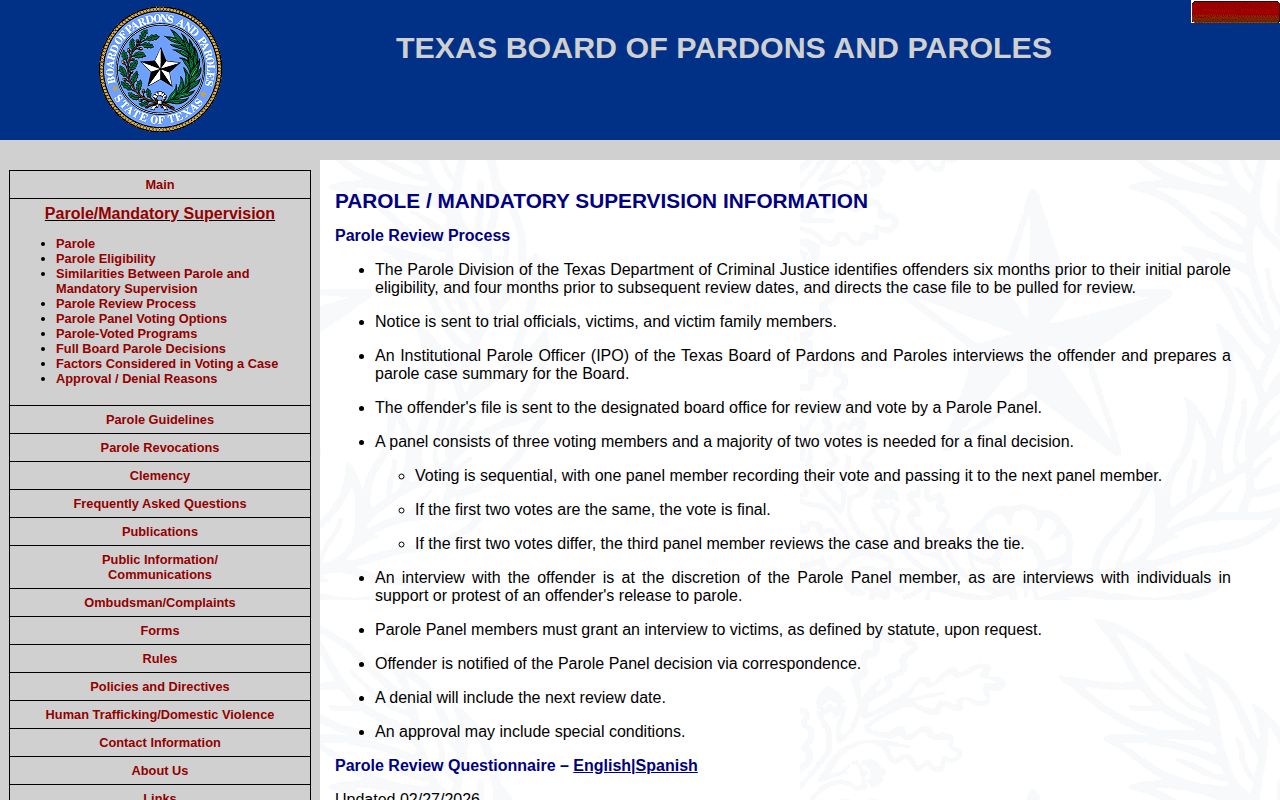
That sequence documents review activity, but only the later release and supervision records confirm that a Comanche County person physically left prison.
Note: Approval for parole, a scheduled release date, physical release, and final discharge are four distinct state record events.
Comanche Supervision Office Split
Comanche County has two geographically different supervision routes. The official TDCJ county cross-reference assigns state parole and mandatory supervision to the Brownwood District Parole Office in Region V. Court-ordered probation routes to Comanche County Community Supervision and Corrections Department. The right office follows the legal mechanism, not the person's place of arrest.
Brownwood District Parole Office
907 Main Street
Brownwood, TX 76801
325-646-0588
Fax: 325-646-0686
Comanche County CSCD
300 Industrial Boulevard
Comanche, TX 76442
325-356-2181
Fax: 325-356-5525
The TDCJ county office cross-reference and official CSCD directory support that division. Office assignment can depend on residence and current agency practice, so use the title, official directory, and case record instead of relying on a staff name that may change.
Comanche Supervision Status Changes
Conditions are enforceable terms of release or probation. They can include reporting, approved residence, treatment, travel limits, or other person-specific duties stated in the order or release certificate. A general list cannot establish what applies to one person. Obtain the controlling document and any later modification.
A violation allegation does not erase the original release. It can begin a warrant, hearing, modification, or revocation process. An absconder is a person the supervising authority alleges has stopped complying or reporting and whose whereabouts may be unknown. That label should come from a current official source. An old repost or search snippet cannot prove a live warrant.
TDCJ publishes a limited Sex Offender Absconder Information Search and lists a parole absconder tip line at 866-680-6667. The search applies only to its named category, and the tip line is not a general status locator. Verify a warrant through the issuing or supervising authority. Probation changes should be checked in the court file because the signed order documents modification, revocation, a jail sanction, or reinstatement.
How Comanche Supervision Ends
Leaving the jail is not the end of supervision. A parolee or mandatory-supervision releasee remains subject to the TDCJ sentence until the agency records discharge or another lawful end. A probationer remains under the court order until completion, early termination, revocation, or another signed action. Ask for the final record rather than calculating an end from an old start date.
For parole, request TDCJ incarceration and supervision history when the live current-prison search no longer helps. General inmate information is available weekdays through 936-295-6371 or 800-535-0283. Questions about supervision or location can route through the Parole Division's published io@tdcj.texas.gov channel. Open records route through pia@tdcj.texas.gov.
For probation, start with the clerk for the sentencing court. The public judgment and later orders can show the imposed term, changes, revocation, or completion. CSCD staff may be limited in what they disclose, so the public court order remains the primary record when person-specific supervision details are restricted.
The Comanche County released inmate search explains how to obtain the underlying county release record before tracing supervision.
Comanche Supervision Record Sources
Texas Government Code Chapter 552 governs access to executive-branch public information, subject to exceptions. A request should go to the agency that holds the existing record. Ask TDCJ for state release, incarceration, or supervision history. Ask the sheriff for the county release or transfer transaction. Do not ask one agency to research another agency's file.
Judicial records follow court and clerk procedures rather than the same Public Information Act route. That distinction is crucial for probation. The sheriff records physical jail departure, while the court records the order that imposed or changed community supervision. A CSCD entry may help confirm administration, but it does not replace the signed judgment.
When records conflict, preserve their timestamps and identifiers. A jail exit time can post after a court order. TDCJ's public current-prison data can lag by at least 24 hours on working days. An office directory shows routing, not a person's status. Ask the record-owning agencies to reconcile the specific transaction.
The Texas Board of Pardons and Paroles does not conduct a formal public hearing for ordinary parole or mandatory-supervision review. Panel members vote the file. That process has no Comanche County courtroom calendar to search. For a person still in TDCJ custody, the active detail can show parole review information. BPP lists 844-512-0461 for decision status, while Review and Release Processing lists 512-406-5202 after approval. Neither eligibility nor a favorable vote proves physical release.
A denial can state the next review date, while an approval may impose conditions or depend on program completion. New information can also affect an approval. Government Code Section 508.145 primarily governs parole eligibility, and Section 508.149 lists mandatory-supervision exclusions. Offense dates and statutory categories matter, so a projected or review date should not be converted into a promised departure date.
Comanche Custody and Supervision
County custody, state custody, and supervision should remain separate. A person moved from Comanche County Jail to TDCJ was transferred, not released to the community. A later parole release can place that person under the Brownwood office. A defendant ordered directly to probation may never have served a TDCJ prison term.
| Record language | Next verification source |
|---|---|
| Released on bond or court order | Jail release line and signed court record |
| Transferred to TDCJ | TDCJ intake and current-prison record |
| Released to parole or mandatory supervision | TDCJ Parole Division and Brownwood DPO |
| Placed on community supervision | Sentencing court and Comanche County CSCD |
| Discharged | Final TDCJ or court completion record |
This map also guards against treating a current jail roster as a supervision search. Released people usually leave that roster. Their status persists, if at all, in TDCJ, Parole Division, CSCD, and court records.
Public Record Search
Sponsored Results