
Comanche County Release Date Types
Texas records use several dates, each answering a different question. The TDCJ definitions separate projected release from maximum expiration, parole eligibility, and mandatory supervision. A projected date is an administrative estimate based on sentence data and applicable rules. It is not a promise that the prison gate will open that day.
- Eligibility date
- The earliest point when legal review may be possible, not an order of release.
- Projected release date
- TDCJ's current calculation based on sentence and applicable time-credit rules.
- Scheduled release date
- A date posted after approvals, plan work, and processing have moved farther along.
- Actual release date
- The date physical custody ended at the named agency.
- Discharge
- Completion of the sentence obligation, which differs from release to parole supervision.
A Comanche County jail record may use release date or booking-out time instead of TDCJ's projected field. Court orders show sentence and jail credit, but the signed order alone may not capture a later hold or receiving agency.
Find Comanche County Projections
Begin by deciding whether custody is local or state. The current jail roster covers people housed by Comanche County, but it is not a sentence calculator. TDCJ's public search applies after a felony transfer into state custody. A transfer from the county jail to TDCJ is not community release.
- Check the Comanche County roster and note booking, charge, docket, court, sentence, hold, and ID fields.
- For a county sentence, obtain the signed judgment and jail-credit order from the correct clerk.
- Ask the jail at 325-356-2333 for the current calculated release status and any hold.
- For state custody, use the TDCJ inmate search by name, TDCJ number, or SID.
- Compare projected release, parole eligibility, maximum sentence, and parole-review information.
- After the date, confirm physical departure through the responsible agency record.
The TDCJ form also permits first and last name, gender, and race fields. Similar names require a date-of-birth or identifier check. The official search screen below shows the statewide route for a Comanche County defendant who has entered TDCJ custody.
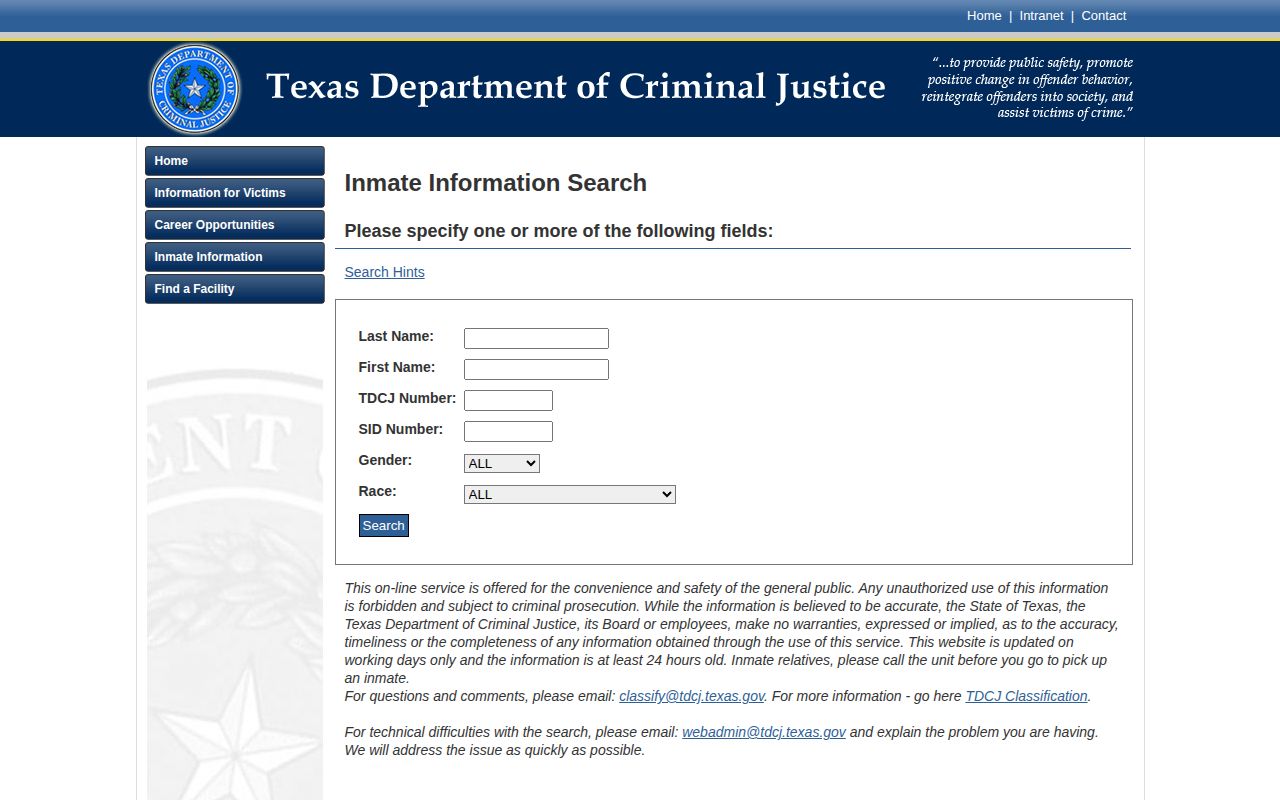
The state search is not a historical county-jail release index. Former prisoners may require the TDCJ email, telephone, or records channel if the active interface no longer supplies enough history.
Comanche County Date Changes
Release calculations change when source facts or legal status change. A corrected jail-credit entry may move a date. Good-conduct credits can be forfeited or restored. A parole panel may approve or deny release, a required program may not yet be complete, or a release plan may still need approval. Detainers, warrants, sentence audits, and new court orders can also prevent the expected departure.
| Change | Effect |
|---|---|
| Corrected jail credit | Recalculates time already credited toward the sentence. |
| Good-time change | Changes an administrative or eligibility calculation where the law permits. |
| BPP decision | May approve, delay, or deny parole or discretionary mandatory supervision. |
| Program or plan | Can delay scheduling until a condition or placement is complete. |
| Detainer or warrant | May send the person to another agency instead of the community. |
| Record audit | Can correct the date even after a release certificate is issued. |
The TDCJ Ombudsman reports that an audit after a release certificate can take about 14 to 21 business days, while program-related processing often takes four to six weeks. It also warns that a scheduled date can change on release day. Those ranges describe state processing, not Comanche County Jail practice.
Note: A scheduled state date should be checked again after departure because approval and physical release are separate events.
Texas Has No 85% Rule
Texas does not impose one blanket rule requiring every TDCJ prisoner to serve 85 percent. That shorthand is commonly tied to federal time rules, not Texas state imprisonment. For certain serious offenses referenced in Code of Criminal Procedure article 42A.054, Government Code section 508.145 generally calculates parole eligibility using actual calendar time, without good-conduct time, equal to one-half of the sentence or 30 years, whichever is less, subject to a two-calendar-year minimum and offense-specific provisions.
That calculation creates an eligibility point. It does not require the Board of Pardons and Paroles to approve release. Offense date matters as well. Mandatory-supervision treatment differs for pre-September 1, 1996 offenses and later offenses, and some people are excluded. Under later law, an eligible mandatory-supervision case can require BPP approval, and a denial may move the projected date toward maximum expiration.
This Comanche County release-date distinction matters because a percentage estimate can look precise while ignoring the governing offense, date, sentence structure, credits, BPP review, and holds. Use the live TDCJ fields and the individual judgment instead.
Texas Credits Change Comanche Release Dates
Government Code Chapter 498 governs TDCJ classification and good-conduct time. Good time affects administrative and eligibility calculations. It is not a release certificate and does not guarantee a shorter term. Credits may be lost or restored under statute and agency rules.
County jail time follows a separate rule. Code of Criminal Procedure article 42.032 allows a sheriff to grant commutation for good conduct, industry, and obedience, up to one day for each day actually served when no misconduct charge is sustained. The statute also includes limits involving fines, costs, and cumulative sentences.
Ask for the court's actual jail credit and the sheriff's person-specific calculation. A pretrial detainee may leave after bond, dismissal, or a new order rather than after a projected sentence date.
Confirm Comanche County Departure
TDCJ provides an inmate-information email route that defines Projected Release Date and accepts person-specific requests with identifiers. Its published information may include location, offense, projected release, parole eligibility, and maximum sentence dates. Once a state release is approved, Review and Release Processing handles audits and release planning. A parole vote still does not prove the person has left.
The official projected-date definition is shown below as a source for the state field.
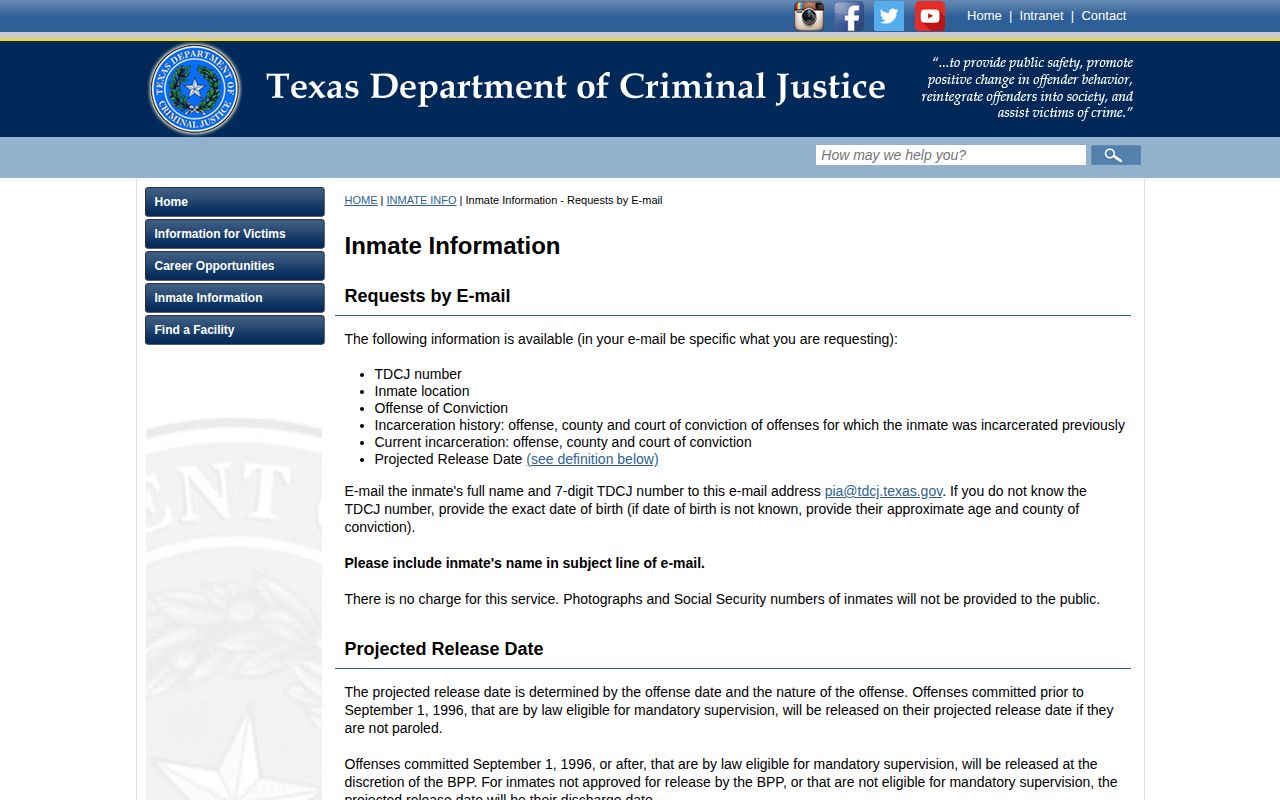
The definition helps interpret the estimate, while the current detail and release record establish the individual outcome.
For a local sentence, call the Comanche County Jail and compare its release entry with the signed court disposition. For state custody, recheck TDCJ or call the release-status channel after the scheduled date. A person-specific custody alert can also be registered through the Comanche County VINELink check, now IVSS-Counties, but the official agency record remains decisive.
Comanche County Jail Release Credits
County jail credit begins with the signed judgment or order, not a rough count from arrest date to today. The Comanche County court record may show the cause number, charge, plea, disposition, sentence, jail credit, community-supervision order, dismissal, and later record action. A docket entry is a lead. Request the signed final document when the calculation turns on exact credited days.
Pretrial custody makes projections especially uncertain. A person held on an unresolved case may leave after bond, dismissal, plea, time-served order, or another judicial act. A hold from another agency may take effect the same day. Because no Comanche-specific weekend or holiday release rule was found, do not move a calculated date to a weekday without confirmation from the jail.
For a felony sentence that has not yet reached TDCJ intake, the county and state systems may show different stages. The sheriff can confirm local transfer, while TDCJ becomes authoritative after admission. Preserve the county booking number, state identifier, and court cause number so the three records can be matched. Actual release is proved by the final custodian's transaction, not by an estimate made earlier in the case.
Comanche County Projected Parole Date
Parole eligibility adds another layer. TDCJ identifies a person for review before the eligibility point, and a panel vote can approve release, deny it, or require a program path. Approval does not fix the gate date by itself. Review and Release Processing may still audit the record, confirm the plan, and establish a release site. A denial may carry a later review date instead of a new projected departure.
Mandatory supervision differs from parole. It is a statutory release framework shaped by offense date, eligibility, time, and exclusions, with discretionary review for many later offenses. Maximum expiration is the sentence endpoint shown by TDCJ calculations. Read these fields together because one date can answer only part of “when will they get out.”
Comanche County Release Status Channels
For every Comanche County calculation, write down the date it was checked and the agency that supplied it. Dynamic fields can change after a vote, audit, credit correction, or new hold. A dated note makes it possible to explain why an earlier estimate differs from the later official release entry and keeps a projection from being mistaken for an unchanging court promise.
TDCJ offers more than the public form. Its inmate-information email instructions accept a full name and TDCJ number or SID, and they define the Projected Release Date field. Telephone inmate information provides another official channel. These routes fit a Comanche County defendant already admitted to state prison, not a person who remains in the county jail.
Once a parole vote favors release, Review and Release Processing handles record review and release-plan work. TDCJ publishes 512-406-5202 for release status after a favorable vote. Parole review results can be requested at 844-512-0461 with the name, TDCJ-CID number, or date of birth. A favorable code, eligibility date, or posted plan does not replace confirmation that the person physically departed.
Government Code sections 508.147 and 508.149 govern mandatory supervision and exclusions. Section 508.145 addresses parole eligibility. These provisions interact with the offense and offense date, so one person's date cannot be calculated by copying another person's percentage. A life sentence and offense-specific subsection can also change the calculation.
For county custody, the signed judgment and sheriff calculation remain central. The District Clerk's official-copy channel advertises certified or official copies at one dollar per page by mail or in person. Ask for the judgment, sentence, and actual jail-credit order. Then ask the jail whether another hold, warrant, or transfer affects the expected release. The court establishes legal credit, while the jail records the local custody transaction.
Comanche County Scheduled Release Date
TDCJ's scheduled release location is another distinct field. Once established, it may identify where release processing is expected to occur, but assignment and timing can still change. The Ombudsman warns that record audits and program steps continue after earlier decisions. Keep the projected date, scheduled date, location, and final release record together instead of treating one screen capture as the whole history.
Maximum expiration also deserves a separate check. It reflects the calculated end of the sentence, while parole or mandatory supervision can place someone outside prison before that endpoint under continuing authority. Full discharge is different from either form of supervised release. Ask which status applies when a Comanche County record merely says “released.”
Public Record Search
Sponsored Results